
Category: Strategy & Wealth Building

  • Why AI SOPs Matter for Service Business Growth

    Why AI SOPs Matter for Service Business Growth

    Why AI SOPs matter

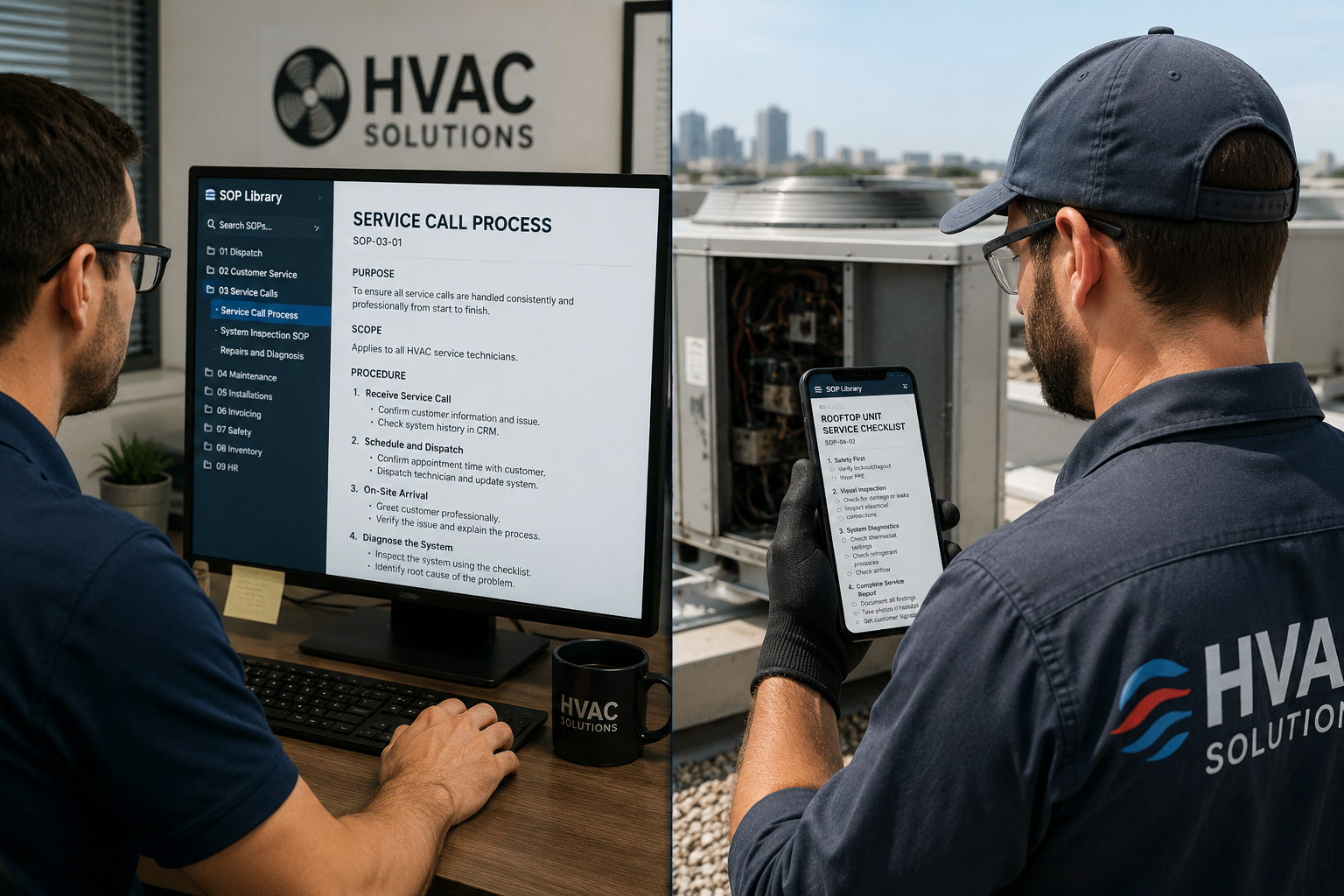
    For many service businesses, growth eventually stalls because too much knowledge stays in the owner’s head, training is inconsistent, and the team relies on memory instead of clear operating systems. AI-supported SOPs help solve that problem by making repeatable work easier to document, access, update, and use across the business.

    For nextSystem.ca clients, AI SOPs are not about adding complexity. They are about creating a more scalable operating company while improving the owner’s ability to build long-term durable assets beyond the business itself.

    What AI SOPs improve

    • Clear process control across office, field, and management workflows
    • Faster team onboarding and more consistent training
    • Reduced owner dependence and less tribal knowledge
    • Better quality control in dispatch, service, estimating, invoicing, and follow-up
    • Easier documentation updates as systems evolve

    Instead of relying on scattered notes, verbal instructions, or paper files, the business can maintain one digital source of truth. That makes execution more repeatable and gives the team a clearer standard for how work should be done.

    Where service companies use them first

    High-value SOPs often begin in the workflows that affect customer experience, cash flow, and operational consistency. In many service businesses, that includes customer intake, dispatch, quoting, field execution, invoicing, collections, maintenance renewals, safety processes, and after-hours response.

    AI can assist by helping draft procedures, structure checklists, organize recurring steps, and make SOP libraries easier to search and maintain. Management still defines the standard, but AI can accelerate the documentation process.

    Why buyers and operators care

    Businesses with stronger SOPs are often easier to scale, easier to transfer, and easier to sell. When key processes are documented and usable, risk drops. Team performance becomes more predictable, training improves, and buyers gain confidence that the business can continue performing without constant founder involvement.

    A business with AI-supported SOPs is easier to train, easier to manage, and easier to grow.

    Connect systems to long-term strategy

    At nextSystem.ca, AI SOPs are part of a broader strategy that links stronger business systems with stronger long-term asset planning. Learn more about Business Systems & SOPs, explore AI Tools, or review the full Why AI SOPs page.

    If you want help building AI SOPs that improve operations and enterprise value, book an assessment.


  • How Retained Earnings and Holdcos Can Support Real Estate Growth

    How Retained Earnings and Holdcos Can Support Real Estate Growth

    Why retained earnings matter

    Established service business owners often build significant value inside the operating company, but many keep too much long-term wealth tied to one business. Retained earnings can create more strategic options when they are evaluated as part of a broader plan that includes diversification, business readiness, and durable asset growth.

    For the right owner, retained earnings may support a move into multifamily and other income-producing real estate through a Holdco structure, helping reduce concentration risk while building a stronger long-term balance sheet.

    Why service owners look at Holdcos

    • To move excess retained earnings beyond the operating company
    • To create more separation between business operations and long-term investments
    • To evaluate ownership, tax, and estate planning more intentionally
    • To support acquisition of tangible, income-producing assets
    • To create another layer of long-term wealth outside future sale multiples

    The exact structure should always be reviewed with qualified legal and tax advisors, but the broader strategic reason is clear: many successful operators want part of their wealth anchored in assets that can outlast the active demands of the business.

    How real estate can fit the plan

    Multifamily real estate often appeals to service business owners because it is operationally understandable. It produces income, can be improved through disciplined management, and may fit well within a longer-term plan for diversification, transition, and retirement income.

    That does not mean every owner should move capital immediately. Liquidity needs, lender requirements, management capacity, business systems, and risk tolerance all matter. The business still needs enough strength and structure to perform while capital is being deployed elsewhere.

    Business systems still matter

    If the operating company depends too heavily on the owner, it becomes harder to think clearly about capital deployment. Strong SOPs, management systems, reporting, and accountability make it easier to evaluate whether retained earnings can be put to work more strategically.

    That is why nextSystem.ca connects durable asset planning with business systems work. The stronger the business becomes, the more optionality the owner may have.

    Retained earnings become more powerful when they are part of a coordinated strategy, not just idle capital inside the business.

    Where to learn more

    Explore JV Multifamily Acquisitions, review How It Works, or see the full Retained Earnings & Real Estate page for a deeper overview.

    If you want to discuss how retained earnings, Holdcos, and business systems fit together, book an assessment.

  • How Service Businesses Can Turn Profits Into Long-Term Real Estate Assets

    How Service Businesses Can Turn Profits Into Long-Term Real Estate Assets

    Why operators look beyond cash flow

    Many service business owners generate strong income but remain heavily tied to the business for wealth creation. That creates concentration risk. If the company slows down, the owner often feels it immediately. One way to diversify is to turn a portion of business profits into long-term real estate assets that can provide stability, appreciation potential, and a path toward durable wealth.

    For the right operator, this is not about chasing trends. It is about converting active income into tangible assets that can outlast the business cycle.

    Why real estate can fit service owners

    • Diversification: Real estate can reduce reliance on one operating company.
    • Asset backing: Multifamily property creates ownership in a tangible income-producing asset.
    • Long-term orientation: Value can be built through operations, improvements, and disciplined management.
    • Capital deployment: Retained earnings and accumulated equity can sometimes be repositioned more strategically.

    A practical path

    Many owners do not want to become full-time landlords. A more practical route can be participation in a structured joint venture or professionally operated multifamily strategy where acquisition, underwriting, operations, and value-add execution are handled with discipline. That allows owners to stay focused on their core company while building exposure to a longer-term asset base.

    What to evaluate first

    • Your current business cash flow and retained earnings position
    • Your time horizon and risk tolerance
    • Whether your business systems are strong enough to support capital deployment
    • The quality of the acquisition and operating strategy
    • The experience of the people managing the asset

    Systems still matter

    Real estate strategy works best when the operating business is also becoming less owner-dependent. If the company cannot function without constant intervention, it becomes harder to free up capital, attention, and confidence for long-term investing. That is why systems, SOPs, and operational visibility remain central to the bigger picture.

    Durable assets are strongest when they are built on top of a business that runs with discipline.

    Final takeaway

    Service businesses can turn profits into long-term real estate assets when they approach the move strategically. The right combination of business systems and asset acquisition can help owners diversify, reduce concentration risk, and build a more durable financial future.

    If you want to explore how business profits, systems, and multifamily strategy can work together, book an assessment with nextSystem.ca.

  • How Service Business Owners Can Use Retained Earnings and Multifamily Real Estate to Build Durable Assets

    How Service Business Owners Can Use Retained Earnings and Multifamily Real Estate to Build Durable Assets

    How Service Business Owners Can Use Retained Earnings and Multifamily Real Estate to Build Durable Assets

    Many successful service business owners generate strong cash flow but still face a long-term wealth problem. Their income is active, their business value may depend heavily on them, and the eventual sale multiple for a service company is often lower than expected. That creates a gap between years of hard work and the durable wealth they want to build.

    One way to address that gap is to use retained earnings and excess capital to move into durable assets. For the right operator, multifamily real estate can provide a practical path to converting business success into long-term tangible value. This is especially relevant for owners who have built profitable companies, accumulated retained earnings, and want more than idle cash or passive uncertainty.

    Why retained earnings alone are not the full strategy

    Retained earnings can strengthen a business, provide flexibility, and create optionality. But leaving capital parked without a broader plan may not create the long-term outcome an owner wants. Inflation, concentration risk, and limited exit value can all reduce the effectiveness of a cash-heavy strategy.

    For many owners, the bigger opportunity is to think beyond the operating company. The question becomes: how can current business success be translated into assets that are more durable, less dependent on daily labor, and better aligned with long-term wealth building?

    Why multifamily real estate appeals to service business owners

    Multifamily real estate offers several characteristics that appeal to established operators. It is tangible. It can generate income. It can benefit from professional operations and value-add improvements. And unlike a small owner-dependent service business, a well-run apartment asset is not typically valued only on the founder’s personal involvement.

    For owners who understand operations, staffing, maintenance, and systems, multifamily can also feel more understandable than abstract investments. The asset has units, expenses, occupancy, financing, and operational levers. That operating logic often resonates with business owners who are used to solving practical problems and improving performance.

    The role of joint ventures

    Not every service business owner wants to source deals, underwrite properties, arrange financing, and manage apartment operations personally. That is where joint venture structures can matter. A joint venture can allow an owner to participate in multifamily acquisitions alongside experienced operators who handle sourcing, underwriting, execution, and ongoing management.

    For the right investor, this can create exposure to durable assets without requiring a full career shift into real estate operations. It can also help bridge the gap between active business income and long-term asset ownership.

    Why this strategy pairs with business systems

    There is an important connection between retained earnings strategy and operational systems. If the business remains overly dependent on the owner, it becomes harder to free up time, confidence, and capital for long-term planning. That is why many owners need two tracks at once: improve the business operating system and deploy capital more intentionally.

    When AI tools, SOPs, training, and software systems reduce owner dependence, the business becomes more stable and more transferable. That can improve enterprise value while also making it easier for the owner to focus on broader wealth-building decisions. In that sense, business systems and durable asset acquisition are not separate ideas. They reinforce each other.

    Who this approach may fit

    This type of strategy is often most relevant for established service business owners who have meaningful retained earnings, a strong operating history, and a desire to diversify beyond the business itself. It may also appeal to owners who have paid-off homes, accredited investor status, or a long-term exit plan that includes reducing concentration in the operating company.

    Examples may include operators in HVAC, elevator repair, fire systems, diesel, refrigeration, and infrastructure maintenance who want to turn years of operating success into a more durable balance sheet.

    Final thought

    Retained earnings and multifamily real estate can be part of a larger strategy to build durable assets beyond the service business itself. For the right owner, the goal is not simply to earn more income. It is to convert business success into long-term value that is more tangible, more diversified, and less dependent on daily effort.

    nextSystem.ca helps service business owners think through both sides of that equation: improving business systems to increase enterprise value and exploring multifamily joint venture opportunities that can support durable long-term asset growth.

  • How Service Business Owners Use AI Systems and Multifamily Acquisitions to Build Long-Term Wealth

    How Service Business Owners Use AI Systems and Multifamily Acquisitions to Build Long-Term Wealth

    Business owner planning growth strategy

    Insights

    How Service Owners Build Durable Wealth

    A practical strategy for combining business systems, AI implementation, and multifamily acquisitions.

    Many service business owners generate strong cash flow but still face a familiar problem: too much value is tied to the owner, too little is converted into durable assets, and the eventual exit may not reflect years of hard work. A stronger long-term strategy is to improve the business itself while also directing retained earnings into assets that can continue producing value.

    For operators in trades and technical service businesses, that often means focusing on two tracks at the same time: building better systems inside the company and acquiring multifamily real estate through the right joint venture structure. Together, these moves can improve enterprise value, reduce operational dependence on the owner, and create another source of long-term wealth.

    Why owner-dependent businesses stall

    Businesses in HVAC, fire systems, elevator repair, diesel service, refrigeration, and infrastructure maintenance often have excellent demand and healthy margins. But many still rely on the owner for estimating, approvals, hiring, troubleshooting, and customer relationships. That creates friction in growth and can reduce what a buyer is willing to pay.

    • Important knowledge lives in people instead of documented systems
    • Training is inconsistent across teams and locations
    • Reporting is delayed or incomplete
    • Quoting, scheduling, and follow-up depend on manual effort
    • The owner remains the bottleneck for decisions and accountability

    When these issues persist, the company may still be profitable, but it is harder to scale, harder to delegate, and harder to sell at a premium.

    How AI implementation supports growth

    AI implementation is most valuable when it is tied to clear operating systems. It is not about adding random tools. It is about improving how work gets done, how teams are trained, and how decisions are made.

    Operational gains

    • Faster SOP creation and updates
    • Better internal documentation
    • Improved onboarding and training support
    • More consistent communication workflows

    Management gains

    • Cleaner reporting and accountability
    • Reduced owner involvement in repeat tasks
    • Better visibility across teams
    • Stronger readiness for growth or sale

    When AI tools are paired with documented processes and team training, the business becomes easier to run and more valuable to future buyers. That is especially important for service owners who want options, not just income.

    Why multifamily acquisition fits this strategy

    Improving the business is only one side of the equation. The other is converting active business cash flow into hard assets. Multifamily acquisition can provide a practical path for owners who want to diversify beyond the operating company and build long-term balance sheet strength.

    Instead of waiting for a future sale to create wealth, owners can begin building durable assets while the business is still producing strong cash flow.

    For the right operator, a 24 to 54 unit apartment building can offer scale, income potential, and value-add opportunities that align with a disciplined acquisition and operations model. Through a joint venture approach, service business owners may be able to participate in multifamily ownership without taking on every function alone.

    A two-track approach for service business owners

    • Track one: strengthen the operating business with systems, SOPs, AI tools, and implementation support
    • Track two: direct retained earnings toward multifamily acquisitions that create long-term asset value

    This combination can help owners improve cash flow quality, reduce concentration risk, and create a more resilient long-term plan. It also supports a better transition when the time comes to step back from day-to-day operations.

    What to focus on first

    • Document the highest-impact workflows in the business
    • Identify where AI can reduce repetitive admin and reporting work
    • Train managers to operate from systems instead of owner memory
    • Review retained earnings and capital structure
    • Assess readiness for joint venture multifamily acquisition

    The goal is not complexity. The goal is control, scalability, and durable wealth creation.

    Final thought

    If you run a successful service business, your company can do more than generate income. With the right systems and the right acquisition strategy, it can become the engine that funds long-term assets and a stronger future.