
Category: Business Systems & SOPs

  • Why AI SOPs Matter for Service Business Growth

    Why AI SOPs Matter for Service Business Growth

    Why AI SOPs matter

    For many service businesses, growth eventually stalls because too much knowledge stays in the owner’s head, training is inconsistent, and the team relies on memory instead of clear operating systems. AI-supported SOPs help solve that problem by making repeatable work easier to document, access, update, and use across the business.

    For nextSystem.ca clients, AI SOPs are not about adding complexity. They are about creating a more scalable operating company while improving the owner’s ability to build long-term durable assets beyond the business itself.

    What AI SOPs improve

    • Clear process control across office, field, and management workflows
    • Faster team onboarding and more consistent training
    • Reduced owner dependence and less tribal knowledge
    • Better quality control in dispatch, service, estimating, invoicing, and follow-up
    • Easier documentation updates as systems evolve

    Instead of relying on scattered notes, verbal instructions, or paper files, the business can maintain one digital source of truth. That makes execution more repeatable and gives the team a clearer standard for how work should be done.

    Where service companies use them first

    High-value SOPs often begin in the workflows that affect customer experience, cash flow, and operational consistency. In many service businesses, that includes customer intake, dispatch, quoting, field execution, invoicing, collections, maintenance renewals, safety processes, and after-hours response.

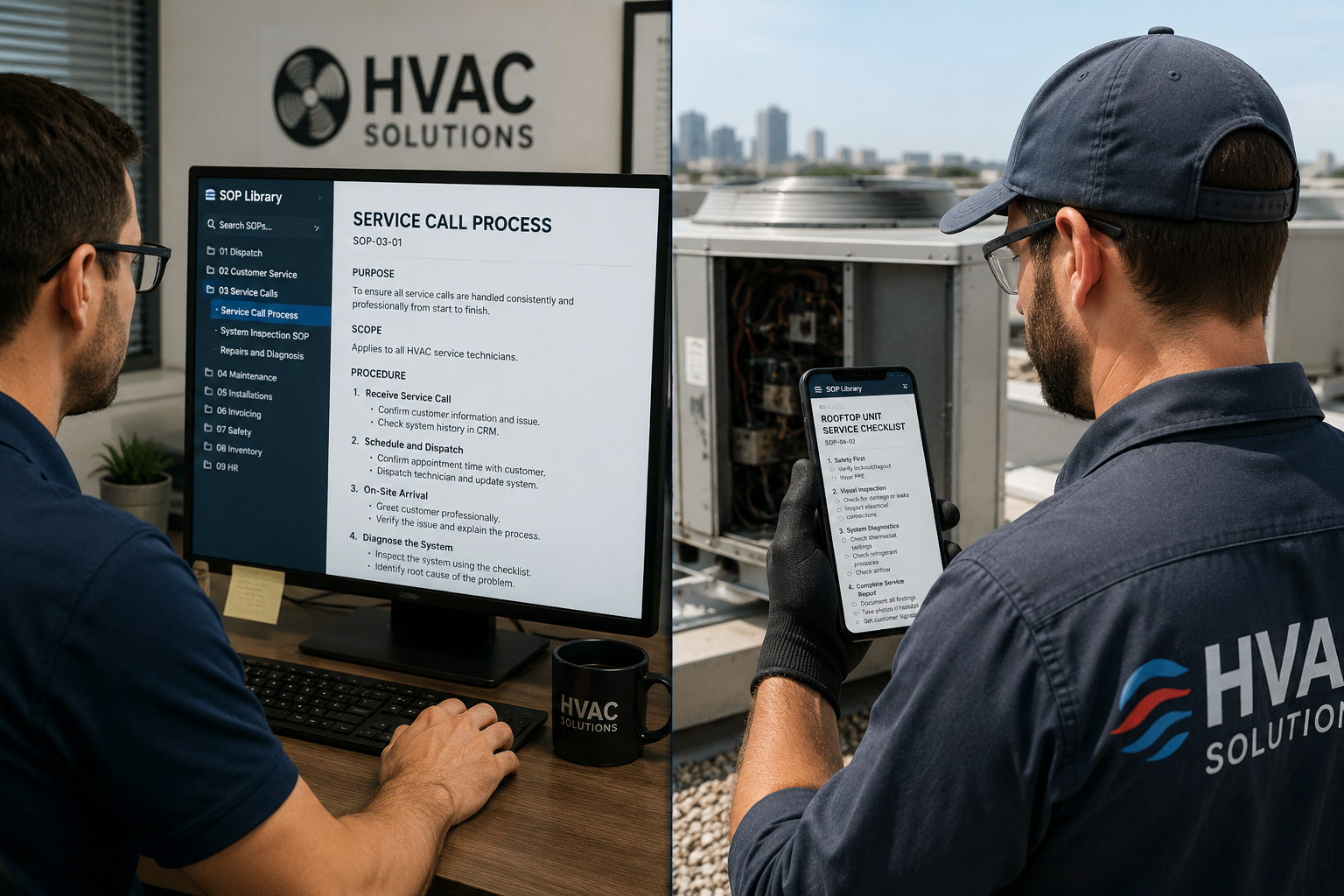
    AI can assist by helping draft procedures, structure checklists, organize recurring steps, and make SOP libraries easier to search and maintain. Management still defines the standard, but AI can accelerate the documentation process.

    Why buyers and operators care

    Businesses with stronger SOPs are often easier to scale, easier to transfer, and easier to sell. When key processes are documented and usable, risk drops. Team performance becomes more predictable, training improves, and buyers gain confidence that the business can continue performing without constant founder involvement.

    A business with AI-supported SOPs is easier to train, easier to manage, and easier to grow.

    Connect systems to long-term strategy

    At nextSystem.ca, AI SOPs are part of a broader strategy that links stronger business systems with stronger long-term asset planning. Learn more about Business Systems & SOPs, explore AI Tools, or review the full Why AI SOPs page.

    If you want help building AI SOPs that improve operations and enterprise value, book an assessment.


  • Reducing Owner Dependence: Systems That Help Service Companies Scale

    Reducing Owner Dependence: Systems That Help Service Companies Scale

    Why owner dependence limits growth

    Many service companies hit a ceiling when the owner becomes the central point for decisions, approvals, problem-solving, and customer escalation. Revenue may grow, but complexity grows faster. Reducing owner dependence is one of the most important steps in building a company that can scale, attract buyers, and create more freedom for leadership.

    The solution is not stepping away blindly. It is building systems that allow the business to perform consistently with clearer roles, better information, and repeatable execution.

    Systems that make the biggest difference

    • Documented SOPs: Teams need clear instructions for recurring work.
    • Defined roles and decision rights: People need to know what they own and when to escalate.
    • Dashboards and reporting: Owners need visibility without being involved in every detail.
    • Workflow automation: Repetitive coordination should happen through systems, not memory.
    • Training and accountability: Systems only work when people are trained and measured against them.

    Where to start

    Start by identifying the points where work stalls unless the owner intervenes. Common examples include quoting approvals, scheduling exceptions, customer issue resolution, hiring decisions, and financial review. These are often signs that the business needs stronger process design and clearer operating rules.

    What scaling really requires

    Scaling is not just adding more people. It requires systems that preserve quality as volume increases. That means documented workflows, better handoffs, stronger management rhythm, and tools that support execution across the team.

    A scalable company is one where performance depends less on heroic effort and more on operating discipline.

    The long-term benefit

    Reducing owner dependence can improve quality of life today while also increasing enterprise value over time. It helps owners make better strategic decisions, prepare for growth, and build a business that is more transferable in the future.

    Final takeaway

    If your company still relies too heavily on the owner, the right systems can create leverage. SOPs, automation, reporting, training, and role clarity work together to help service companies scale with more control and less chaos.

    If you want to reduce owner dependence and build a more scalable operation, contact nextSystem.ca to discuss your current bottlenecks and growth goals.

  • How SOPs Increase Business Value Before You Sell

    How SOPs Increase Business Value Before You Sell

    Why SOPs matter before a sale

    Many service businesses are profitable but still difficult to transfer. When too much knowledge lives in the owner’s head, buyers see risk. Standard operating procedures help reduce that risk by making the business easier to understand, easier to manage, and easier to scale. That can improve buyer confidence and support stronger business value before you sell.

    SOPs are not just internal documents. They are part of the infrastructure that turns a personality-driven company into a more transferable asset.

    How SOPs improve value

    • Reduce owner dependence: Clear procedures help the team operate without constant owner intervention.
    • Improve consistency: Sales, service delivery, onboarding, and customer communication become more repeatable.
    • Support training: New hires ramp up faster when expectations and workflows are documented.
    • Lower operational risk: Buyers are more comfortable when key processes are visible and controlled.
    • Create scalability: A documented business is easier to expand across people, locations, and service lines.

    Which SOPs matter most

    Not every SOP has equal impact. Start with the workflows that affect revenue, customer experience, quality control, and management visibility. In many service companies, that includes lead intake, quoting, scheduling, dispatch, job completion, invoicing, collections, hiring, onboarding, and issue escalation.

    What buyers want to see

    Potential buyers want confidence that performance can continue after the transition. They look for documented systems, role clarity, reporting discipline, and evidence that the company does not rely on one person to solve every problem. Strong SOPs help tell that story.

    A business with documented systems is often easier to diligence, easier to hand off, and easier to believe in.

    How to build SOPs without slowing the business

    • Start with the highest-value recurring processes.
    • Document the current best method in simple language.
    • Assign ownership for updates and training.
    • Use SOPs alongside checklists, templates, and software workflows.
    • Review them regularly as the business evolves.

    Final takeaway

    If you want to increase business value before you sell, SOPs are one of the most practical places to start. They help reduce risk, improve consistency, and make the company more transferable to a future buyer or operator.

    If you want help building SOPs that strengthen enterprise value, contact nextSystem.ca to discuss your current systems and exit goals.

  • Why SOPs Matter for Service Business Growth, Delegation, and Owner Independence

    Why SOPs Matter for Service Business Growth, Delegation, and Owner Independence

    Why SOPs Matter for Service Business Growth, Delegation, and Owner Independence

    Many service businesses hit a ceiling not because demand disappears, but because the owner becomes the system. Every important decision, exception, approval, and customer issue flows through one person. That may feel manageable for a while, but it eventually limits growth, increases stress, and reduces the value of the company.

    This is why SOPs for service business growth matter. Standard operating procedures create consistency, reduce training friction, improve delegation, and make the business less dependent on the founder. For owners who want to scale, step back, or prepare for a future exit, SOPs are not optional. They are infrastructure.

    What SOPs actually do

    SOPs document how work gets done. They define the sequence, standards, responsibilities, and checkpoints for recurring tasks. In a service business, that can include lead intake, dispatch, quoting, job handoff, invoicing, follow-up, technician communication, safety procedures, and customer issue resolution.

    Good SOPs do more than create a manual. They make expectations visible. That helps team members act with more confidence and fewer delays. It also helps management identify where breakdowns are happening and where improvement is needed.

    Why owner dependence is expensive

    When the owner is the only person who knows how to solve problems, approve exceptions, or keep work moving, the business becomes fragile. Growth creates more complexity, but the same person is still expected to hold everything together. That creates slower response times, inconsistent execution, and burnout.

    It also affects enterprise value. Buyers and investors look for businesses that can operate without constant founder involvement. If revenue, customer retention, or team performance depends heavily on one person, the business carries more risk. SOPs help reduce that risk by turning tribal knowledge into repeatable systems.

    Where service businesses need SOPs first

    You do not need to document everything at once. Start with the workflows that affect revenue, customer experience, and team coordination most directly.

    • Lead handling: how inquiries are captured, assigned, and followed up
    • Scheduling and dispatch: how jobs are prioritized and communicated
    • Estimating and proposals: how scopes are prepared and approved
    • Job handoffs: how office staff and field teams transfer information
    • Invoicing and collections: how billing is completed and tracked
    • Customer issue resolution: how complaints, callbacks, and exceptions are handled

    How SOPs support growth

    Growth creates pressure. More jobs, more staff, more customers, and more moving parts all increase the cost of inconsistency. SOPs help absorb that pressure by giving the team a common way to operate. That improves training speed, reduces avoidable mistakes, and makes delegation more realistic.

    When a business has documented processes, managers can coach against a standard instead of relying on memory or preference. New hires ramp faster. Existing team members make fewer assumptions. The owner spends less time answering the same questions repeatedly.

    SOPs and AI are stronger together

    SOPs also make AI implementation more effective. If your process is documented, AI tools can help reinforce it through training, knowledge access, communication support, and workflow automation. If the process is not documented, AI often produces inconsistent results because the business itself is inconsistent.

    That is why many service businesses should treat SOPs as the foundation and AI as the accelerator. Together, they can reduce owner dependence, improve execution, and create a more scalable operating model.

    How SOPs improve delegation

    Delegation fails when expectations are vague. Team members either guess, wait for approval, or escalate issues that should have been handled independently. SOPs reduce that friction by clarifying what good execution looks like and when escalation is required.

    This gives owners room to focus on higher-value work such as strategy, hiring, financial planning, and growth initiatives. Over time, that shift can change the entire trajectory of the business. Instead of being trapped in daily operations, the owner can build a company that functions with more stability and less dependence on their constant presence.

    Final thought

    SOPs for service business growth are not about bureaucracy. They are about clarity, consistency, and freedom. They help teams perform better, help owners delegate more effectively, and help businesses become more valuable over time.

    If your business is growing but still depends too heavily on you, nextSystem.ca helps service business owners build SOPs, systems, and training that support scale, owner independence, and stronger long-term enterprise value.