
Author: nextsystem

  • Why AI SOPs Matter for Service Business Growth

    Why AI SOPs Matter for Service Business Growth

    Why AI SOPs matter

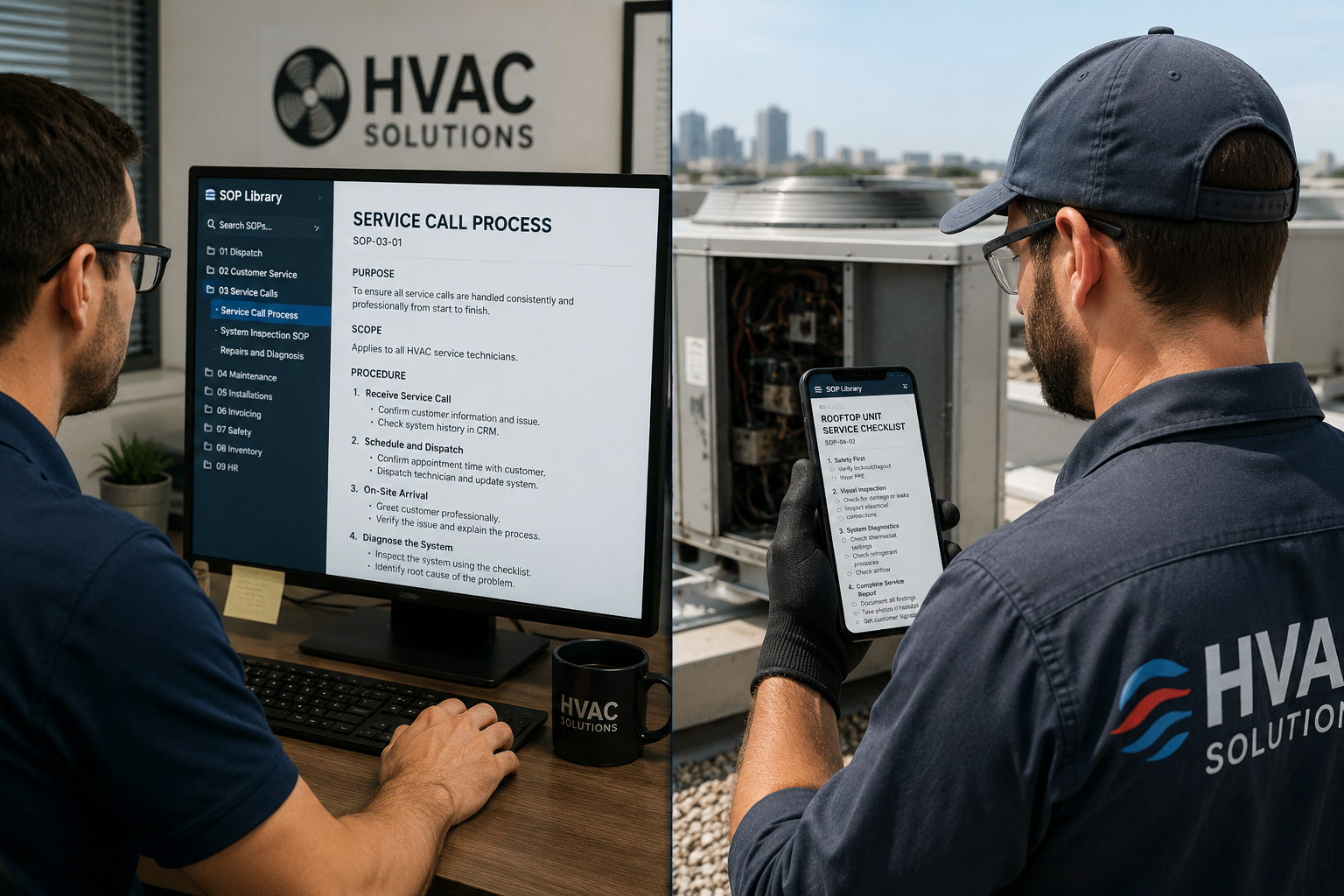
    For many service businesses, growth eventually stalls because too much knowledge stays in the owner’s head, training is inconsistent, and the team relies on memory instead of clear operating systems. AI-supported SOPs help solve that problem by making repeatable work easier to document, access, update, and use across the business.

    For nextSystem.ca clients, AI SOPs are not about adding complexity. They are about creating a more scalable operating company while improving the owner’s ability to build long-term durable assets beyond the business itself.

    What AI SOPs improve

    • Clear process control across office, field, and management workflows
    • Faster team onboarding and more consistent training
    • Reduced owner dependence and less tribal knowledge
    • Better quality control in dispatch, service, estimating, invoicing, and follow-up
    • Easier documentation updates as systems evolve

    Instead of relying on scattered notes, verbal instructions, or paper files, the business can maintain one digital source of truth. That makes execution more repeatable and gives the team a clearer standard for how work should be done.

    Where service companies use them first

    High-value SOPs often begin in the workflows that affect customer experience, cash flow, and operational consistency. In many service businesses, that includes customer intake, dispatch, quoting, field execution, invoicing, collections, maintenance renewals, safety processes, and after-hours response.

    AI can assist by helping draft procedures, structure checklists, organize recurring steps, and make SOP libraries easier to search and maintain. Management still defines the standard, but AI can accelerate the documentation process.

    Why buyers and operators care

    Businesses with stronger SOPs are often easier to scale, easier to transfer, and easier to sell. When key processes are documented and usable, risk drops. Team performance becomes more predictable, training improves, and buyers gain confidence that the business can continue performing without constant founder involvement.

    A business with AI-supported SOPs is easier to train, easier to manage, and easier to grow.

    Connect systems to long-term strategy

    At nextSystem.ca, AI SOPs are part of a broader strategy that links stronger business systems with stronger long-term asset planning. Learn more about Business Systems & SOPs, explore AI Tools, or review the full Why AI SOPs page.

    If you want help building AI SOPs that improve operations and enterprise value, book an assessment.


  • How Retained Earnings and Holdcos Can Support Real Estate Growth

    How Retained Earnings and Holdcos Can Support Real Estate Growth

    Why retained earnings matter

    Established service business owners often build significant value inside the operating company, but many keep too much long-term wealth tied to one business. Retained earnings can create more strategic options when they are evaluated as part of a broader plan that includes diversification, business readiness, and durable asset growth.

    For the right owner, retained earnings may support a move into multifamily and other income-producing real estate through a Holdco structure, helping reduce concentration risk while building a stronger long-term balance sheet.

    Why service owners look at Holdcos

    • To move excess retained earnings beyond the operating company
    • To create more separation between business operations and long-term investments
    • To evaluate ownership, tax, and estate planning more intentionally
    • To support acquisition of tangible, income-producing assets
    • To create another layer of long-term wealth outside future sale multiples

    The exact structure should always be reviewed with qualified legal and tax advisors, but the broader strategic reason is clear: many successful operators want part of their wealth anchored in assets that can outlast the active demands of the business.

    How real estate can fit the plan

    Multifamily real estate often appeals to service business owners because it is operationally understandable. It produces income, can be improved through disciplined management, and may fit well within a longer-term plan for diversification, transition, and retirement income.

    That does not mean every owner should move capital immediately. Liquidity needs, lender requirements, management capacity, business systems, and risk tolerance all matter. The business still needs enough strength and structure to perform while capital is being deployed elsewhere.

    Business systems still matter

    If the operating company depends too heavily on the owner, it becomes harder to think clearly about capital deployment. Strong SOPs, management systems, reporting, and accountability make it easier to evaluate whether retained earnings can be put to work more strategically.

    That is why nextSystem.ca connects durable asset planning with business systems work. The stronger the business becomes, the more optionality the owner may have.

    Retained earnings become more powerful when they are part of a coordinated strategy, not just idle capital inside the business.

    Where to learn more

    Explore JV Multifamily Acquisitions, review How It Works, or see the full Retained Earnings & Real Estate page for a deeper overview.

    If you want to discuss how retained earnings, Holdcos, and business systems fit together, book an assessment.

  • What Accredited Service Business Owners Should Know About Multifamily JV Investing

    What Accredited Service Business Owners Should Know About Multifamily JV Investing

    Why this matters now

    Many established service business owners generate strong cash flow but keep too much of their long-term financial future tied to one operating company. For accredited investors, multifamily joint venture investing can offer a way to diversify into tangible assets while staying aligned with experienced operators and structured opportunities.

    For nextSystem.ca clients, this is not about chasing trends. It is about using business success to build durable assets that can complement enterprise value, support future transition planning, and create another layer of long-term wealth.

    Why multifamily appeals to operators

    • It is backed by a real, income-producing asset
    • Demand for housing tends to remain resilient
    • Value can often be improved through operations and repositioning
    • It can provide diversification away from a single business
    • It aligns well with owners who understand operations and cash flow

    Owners in trades, maintenance, and infrastructure-related businesses often appreciate multifamily because it is operationally understandable. Revenue, occupancy, expenses, financing, and value-add plans can be evaluated with the same disciplined thinking they already use in business.

    What to evaluate in a JV opportunity

    • The experience and track record of the operating team
    • The quality of underwriting assumptions
    • The business plan for renovations, leasing, and management
    • Capital structure, fees, and investor alignment
    • Risk factors, hold period, and exit scenarios

    Not every deal is a fit. Investors should understand how the property creates value, what could go wrong, and how the team plans to execute. A disciplined process matters more than a polished pitch.

    How it fits a broader strategy

    Multifamily JV investing works best when it is part of a larger plan. That plan may include improving the operating company, increasing retained earnings, reducing owner dependence, and deciding how much capital should remain in the business versus move into long-term assets.

    That is why nextSystem.ca combines operational systems work with asset strategy. The stronger the business becomes, the more options the owner may have for diversification, timing, and long-term planning.

    Where to learn more

    Explore JV Multifamily Acquisitions, review Retained Earnings & Real Estate, and see the nextSystem strategy to understand how operations and asset-building can work together.

    The right asset strategy should support the business owner, not distract from the business that created the opportunity.

    If you want to discuss whether this approach fits your situation, book an assessment.

  • How to Prepare a Service Business for Sale Without Slowing Growth

    How to Prepare a Service Business for Sale Without Slowing Growth

    Why preparation matters

    Many service business owners wait too long to prepare for a future sale. They focus on revenue, keep solving problems personally, and assume a buyer will value the business based on effort and reputation alone. In practice, buyers look for transferable systems, reliable margins, and a company that can keep performing without the owner in the middle of every decision.

    For nextSystem.ca clients, the goal is not only to improve eventual sale value. It is also to strengthen the business while it is still producing cash flow, so the owner has more freedom, more visibility, and more options for deploying retained earnings into durable assets such as multifamily real estate.

    What buyers want to see

    • Documented SOPs for core workflows
    • Clear financial reporting and operational KPIs
    • Reduced owner dependence in sales, delivery, and management
    • Reliable team performance and accountability
    • Technology systems that improve consistency and reporting

    If a buyer believes the company depends too heavily on the founder, risk goes up and valuation pressure follows. If they see a business with repeatable processes and strong management rhythm, the business becomes easier to finance, easier to transition, and more attractive in the market.

    The best time to start

    The best time to prepare a service business for sale is usually years before an exit, not months before one. Improvements made early can increase current profitability, reduce operational drag, and create a stronger foundation for growth. That means the owner benefits now, not just later.

    Examples include standardizing dispatch and scheduling, tightening estimating workflows, documenting onboarding, and using AI tools to reduce repetitive admin work. These changes can improve throughput and lower the amount of decision-making trapped with the owner.

    A practical preparation plan

    • Map the functions the owner still controls directly
    • Document the highest-value SOPs first
    • Implement software and AI where they reduce friction
    • Train managers and team leads to own outcomes
    • Review reporting weekly so performance is visible

    This kind of work can increase enterprise value while also making the business easier to run. It can also support a broader wealth strategy by freeing up time, improving retained earnings, and making it easier to evaluate long-term asset opportunities.

    Connect operations to long-term wealth

    At nextSystem.ca, sale preparation is part of a larger strategy. The aim is to help service business owners build stronger systems, reduce owner dependence, and use business success to create durable assets beyond the operating company. Learn more about Business Systems & SOPs, explore JV Multifamily Acquisitions, or review the process here.

    A business that runs on systems is easier to grow, easier to transfer, and easier to turn into long-term wealth.

    If you want to improve business value before a future exit, book an assessment with nextSystem.ca.

  • Best KPIs for Service Businesses That Want More Profit and Less Owner Dependence

    Best KPIs for Service Businesses That Want More Profit and Less Owner Dependence

    Why KPIs matter

    Many service businesses track revenue, bank balance, and maybe gross margin. That is not enough if the goal is to improve profitability, reduce owner dependence, and build a company that can scale or sell well. The right KPIs help owners see where performance is strong, where bottlenecks exist, and where systems need to improve.

    At nextSystem.ca, KPI discipline supports both operational improvement and long-term enterprise value. Better visibility leads to better decisions, stronger delegation, and more confidence when planning for growth or durable asset acquisition.

    Core KPIs to monitor

    • Lead-to-close conversion rate
    • Average job value or contract value
    • Gross margin by service line
    • Technician or crew utilization
    • Callback and rework rate
    • Accounts receivable aging
    • Customer retention and repeat revenue
    • Owner-involved decisions per week

    These metrics do more than describe performance. They reveal whether the business is becoming more transferable and less dependent on founder intervention. For example, if owner-involved decisions remain high, the business likely needs clearer SOPs, better training, or stronger management systems.

    Use KPIs to guide systems work

    KPIs become more valuable when they connect directly to action. If gross margin is inconsistent, estimate quality and job costing may need attention. If rework is high, training and SOP compliance may be weak. If receivables are slipping, billing workflows and accountability may need to be tightened.

    This is where AI and software can help. Dashboards, automated reporting, workflow triggers, and documented procedures can make performance easier to monitor and improve without relying on memory or constant owner oversight.

    Keep the scorecard simple

    Do not overload the team with dozens of metrics. Start with a focused scorecard that reflects sales performance, delivery quality, cash flow, and management effectiveness. Review it consistently and tie each KPI to an owner or manager who is responsible for improvement.

    Build a stronger company

    When service businesses track the right KPIs, they become easier to manage, easier to improve, and easier to scale. That supports stronger profitability today and better enterprise value over time. Learn more about AI/Software Enablement, Business Systems & SOPs, and why AI SOPs matter.

    You cannot reduce owner dependence if the business cannot clearly see what drives performance.

    If you want help building a practical KPI and systems framework, book an assessment.

  • How Service Businesses Can Turn Profits Into Long-Term Real Estate Assets

    How Service Businesses Can Turn Profits Into Long-Term Real Estate Assets

    Why operators look beyond cash flow

    Many service business owners generate strong income but remain heavily tied to the business for wealth creation. That creates concentration risk. If the company slows down, the owner often feels it immediately. One way to diversify is to turn a portion of business profits into long-term real estate assets that can provide stability, appreciation potential, and a path toward durable wealth.

    For the right operator, this is not about chasing trends. It is about converting active income into tangible assets that can outlast the business cycle.

    Why real estate can fit service owners

    • Diversification: Real estate can reduce reliance on one operating company.
    • Asset backing: Multifamily property creates ownership in a tangible income-producing asset.
    • Long-term orientation: Value can be built through operations, improvements, and disciplined management.
    • Capital deployment: Retained earnings and accumulated equity can sometimes be repositioned more strategically.

    A practical path

    Many owners do not want to become full-time landlords. A more practical route can be participation in a structured joint venture or professionally operated multifamily strategy where acquisition, underwriting, operations, and value-add execution are handled with discipline. That allows owners to stay focused on their core company while building exposure to a longer-term asset base.

    What to evaluate first

    • Your current business cash flow and retained earnings position
    • Your time horizon and risk tolerance
    • Whether your business systems are strong enough to support capital deployment
    • The quality of the acquisition and operating strategy
    • The experience of the people managing the asset

    Systems still matter

    Real estate strategy works best when the operating business is also becoming less owner-dependent. If the company cannot function without constant intervention, it becomes harder to free up capital, attention, and confidence for long-term investing. That is why systems, SOPs, and operational visibility remain central to the bigger picture.

    Durable assets are strongest when they are built on top of a business that runs with discipline.

    Final takeaway

    Service businesses can turn profits into long-term real estate assets when they approach the move strategically. The right combination of business systems and asset acquisition can help owners diversify, reduce concentration risk, and build a more durable financial future.

    If you want to explore how business profits, systems, and multifamily strategy can work together, book an assessment with nextSystem.ca.

  • How SOPs Increase Business Value Before You Sell

    How SOPs Increase Business Value Before You Sell

    Why SOPs matter before a sale

    Many service businesses are profitable but still difficult to transfer. When too much knowledge lives in the owner’s head, buyers see risk. Standard operating procedures help reduce that risk by making the business easier to understand, easier to manage, and easier to scale. That can improve buyer confidence and support stronger business value before you sell.

    SOPs are not just internal documents. They are part of the infrastructure that turns a personality-driven company into a more transferable asset.

    How SOPs improve value

    • Reduce owner dependence: Clear procedures help the team operate without constant owner intervention.
    • Improve consistency: Sales, service delivery, onboarding, and customer communication become more repeatable.
    • Support training: New hires ramp up faster when expectations and workflows are documented.
    • Lower operational risk: Buyers are more comfortable when key processes are visible and controlled.
    • Create scalability: A documented business is easier to expand across people, locations, and service lines.

    Which SOPs matter most

    Not every SOP has equal impact. Start with the workflows that affect revenue, customer experience, quality control, and management visibility. In many service companies, that includes lead intake, quoting, scheduling, dispatch, job completion, invoicing, collections, hiring, onboarding, and issue escalation.

    What buyers want to see

    Potential buyers want confidence that performance can continue after the transition. They look for documented systems, role clarity, reporting discipline, and evidence that the company does not rely on one person to solve every problem. Strong SOPs help tell that story.

    A business with documented systems is often easier to diligence, easier to hand off, and easier to believe in.

    How to build SOPs without slowing the business

    • Start with the highest-value recurring processes.
    • Document the current best method in simple language.
    • Assign ownership for updates and training.
    • Use SOPs alongside checklists, templates, and software workflows.
    • Review them regularly as the business evolves.

    Final takeaway

    If you want to increase business value before you sell, SOPs are one of the most practical places to start. They help reduce risk, improve consistency, and make the company more transferable to a future buyer or operator.

    If you want help building SOPs that strengthen enterprise value, contact nextSystem.ca to discuss your current systems and exit goals.

  • Reducing Owner Dependence: Systems That Help Service Companies Scale

    Reducing Owner Dependence: Systems That Help Service Companies Scale

    Why owner dependence limits growth

    Many service companies hit a ceiling when the owner becomes the central point for decisions, approvals, problem-solving, and customer escalation. Revenue may grow, but complexity grows faster. Reducing owner dependence is one of the most important steps in building a company that can scale, attract buyers, and create more freedom for leadership.

    The solution is not stepping away blindly. It is building systems that allow the business to perform consistently with clearer roles, better information, and repeatable execution.

    Systems that make the biggest difference

    • Documented SOPs: Teams need clear instructions for recurring work.
    • Defined roles and decision rights: People need to know what they own and when to escalate.
    • Dashboards and reporting: Owners need visibility without being involved in every detail.
    • Workflow automation: Repetitive coordination should happen through systems, not memory.
    • Training and accountability: Systems only work when people are trained and measured against them.

    Where to start

    Start by identifying the points where work stalls unless the owner intervenes. Common examples include quoting approvals, scheduling exceptions, customer issue resolution, hiring decisions, and financial review. These are often signs that the business needs stronger process design and clearer operating rules.

    What scaling really requires

    Scaling is not just adding more people. It requires systems that preserve quality as volume increases. That means documented workflows, better handoffs, stronger management rhythm, and tools that support execution across the team.

    A scalable company is one where performance depends less on heroic effort and more on operating discipline.

    The long-term benefit

    Reducing owner dependence can improve quality of life today while also increasing enterprise value over time. It helps owners make better strategic decisions, prepare for growth, and build a business that is more transferable in the future.

    Final takeaway

    If your company still relies too heavily on the owner, the right systems can create leverage. SOPs, automation, reporting, training, and role clarity work together to help service companies scale with more control and less chaos.

    If you want to reduce owner dependence and build a more scalable operation, contact nextSystem.ca to discuss your current bottlenecks and growth goals.

  • AI Automation for Service Businesses: Best Processes to Automate First

    AI Automation for Service Businesses: Best Processes to Automate First

    Why automation matters

    For many service business owners, growth creates complexity before it creates freedom. More leads, more jobs, more technicians, more follow-up, and more admin work can quickly turn into bottlenecks. AI automation for service businesses works best when it removes repetitive tasks first, improves response time, and helps your team execute consistently without adding management overhead.

    The goal is not to automate everything. The goal is to automate the right processes first so your business becomes faster, more reliable, and less dependent on the owner for day-to-day coordination.

    Best processes to automate first

    • Lead capture and routing: Automatically collect inquiries from forms, ads, and calls, then route them to the right person or workflow.
    • Follow-up sequences: Send immediate replies, appointment reminders, estimate follow-ups, and reactivation messages to reduce lead leakage.
    • Scheduling coordination: Use automation to confirm appointments, notify staff, and reduce manual back-and-forth.
    • Customer communication: Standardize updates for arrival windows, job status, next steps, and review requests.
    • Internal task handoffs: Trigger checklists, approvals, and notifications when a sale closes or a job changes stage.
    • Reporting and dashboards: Pull core data into simple scorecards so owners can see performance without chasing updates.

    Where service companies get quick wins

    High-intent automation opportunities usually sit between marketing, sales, operations, and customer service. If your team is manually copying information between systems, repeatedly answering the same questions, or relying on one person to keep work moving, there is likely a strong automation opportunity.

    The best early automation projects save time, reduce missed follow-up, and improve consistency without disrupting service delivery.

    What to avoid

    Do not start with complex automations built on broken processes. If the underlying workflow is unclear, automation will only make confusion happen faster. Document the process first, define ownership, and then automate the repeatable steps.

    A practical rollout plan

    • Identify one repetitive workflow that affects revenue or response time.
    • Document the current steps and decision points.
    • Remove unnecessary steps before automating.
    • Implement one automation with clear success metrics.
    • Train the team and review results weekly.

    Final takeaway

    AI automation for service businesses creates the best results when it supports real operating discipline. Start with lead handling, follow-up, scheduling, communication, and task handoffs. Those areas often produce the fastest return and create the foundation for broader systemization.

    If you want help identifying the best processes to automate first, book an assessment with nextSystem.ca to review your workflows, systems, and growth priorities.

  • Why SOPs Matter for Service Business Growth, Delegation, and Owner Independence

    Why SOPs Matter for Service Business Growth, Delegation, and Owner Independence

    Why SOPs Matter for Service Business Growth, Delegation, and Owner Independence

    Many service businesses hit a ceiling not because demand disappears, but because the owner becomes the system. Every important decision, exception, approval, and customer issue flows through one person. That may feel manageable for a while, but it eventually limits growth, increases stress, and reduces the value of the company.

    This is why SOPs for service business growth matter. Standard operating procedures create consistency, reduce training friction, improve delegation, and make the business less dependent on the founder. For owners who want to scale, step back, or prepare for a future exit, SOPs are not optional. They are infrastructure.

    What SOPs actually do

    SOPs document how work gets done. They define the sequence, standards, responsibilities, and checkpoints for recurring tasks. In a service business, that can include lead intake, dispatch, quoting, job handoff, invoicing, follow-up, technician communication, safety procedures, and customer issue resolution.

    Good SOPs do more than create a manual. They make expectations visible. That helps team members act with more confidence and fewer delays. It also helps management identify where breakdowns are happening and where improvement is needed.

    Why owner dependence is expensive

    When the owner is the only person who knows how to solve problems, approve exceptions, or keep work moving, the business becomes fragile. Growth creates more complexity, but the same person is still expected to hold everything together. That creates slower response times, inconsistent execution, and burnout.

    It also affects enterprise value. Buyers and investors look for businesses that can operate without constant founder involvement. If revenue, customer retention, or team performance depends heavily on one person, the business carries more risk. SOPs help reduce that risk by turning tribal knowledge into repeatable systems.

    Where service businesses need SOPs first

    You do not need to document everything at once. Start with the workflows that affect revenue, customer experience, and team coordination most directly.

    • Lead handling: how inquiries are captured, assigned, and followed up
    • Scheduling and dispatch: how jobs are prioritized and communicated
    • Estimating and proposals: how scopes are prepared and approved
    • Job handoffs: how office staff and field teams transfer information
    • Invoicing and collections: how billing is completed and tracked
    • Customer issue resolution: how complaints, callbacks, and exceptions are handled

    How SOPs support growth

    Growth creates pressure. More jobs, more staff, more customers, and more moving parts all increase the cost of inconsistency. SOPs help absorb that pressure by giving the team a common way to operate. That improves training speed, reduces avoidable mistakes, and makes delegation more realistic.

    When a business has documented processes, managers can coach against a standard instead of relying on memory or preference. New hires ramp faster. Existing team members make fewer assumptions. The owner spends less time answering the same questions repeatedly.

    SOPs and AI are stronger together

    SOPs also make AI implementation more effective. If your process is documented, AI tools can help reinforce it through training, knowledge access, communication support, and workflow automation. If the process is not documented, AI often produces inconsistent results because the business itself is inconsistent.

    That is why many service businesses should treat SOPs as the foundation and AI as the accelerator. Together, they can reduce owner dependence, improve execution, and create a more scalable operating model.

    How SOPs improve delegation

    Delegation fails when expectations are vague. Team members either guess, wait for approval, or escalate issues that should have been handled independently. SOPs reduce that friction by clarifying what good execution looks like and when escalation is required.

    This gives owners room to focus on higher-value work such as strategy, hiring, financial planning, and growth initiatives. Over time, that shift can change the entire trajectory of the business. Instead of being trapped in daily operations, the owner can build a company that functions with more stability and less dependence on their constant presence.

    Final thought

    SOPs for service business growth are not about bureaucracy. They are about clarity, consistency, and freedom. They help teams perform better, help owners delegate more effectively, and help businesses become more valuable over time.

    If your business is growing but still depends too heavily on you, nextSystem.ca helps service business owners build SOPs, systems, and training that support scale, owner independence, and stronger long-term enterprise value.